The First Crack
Meera Joshi · 2041
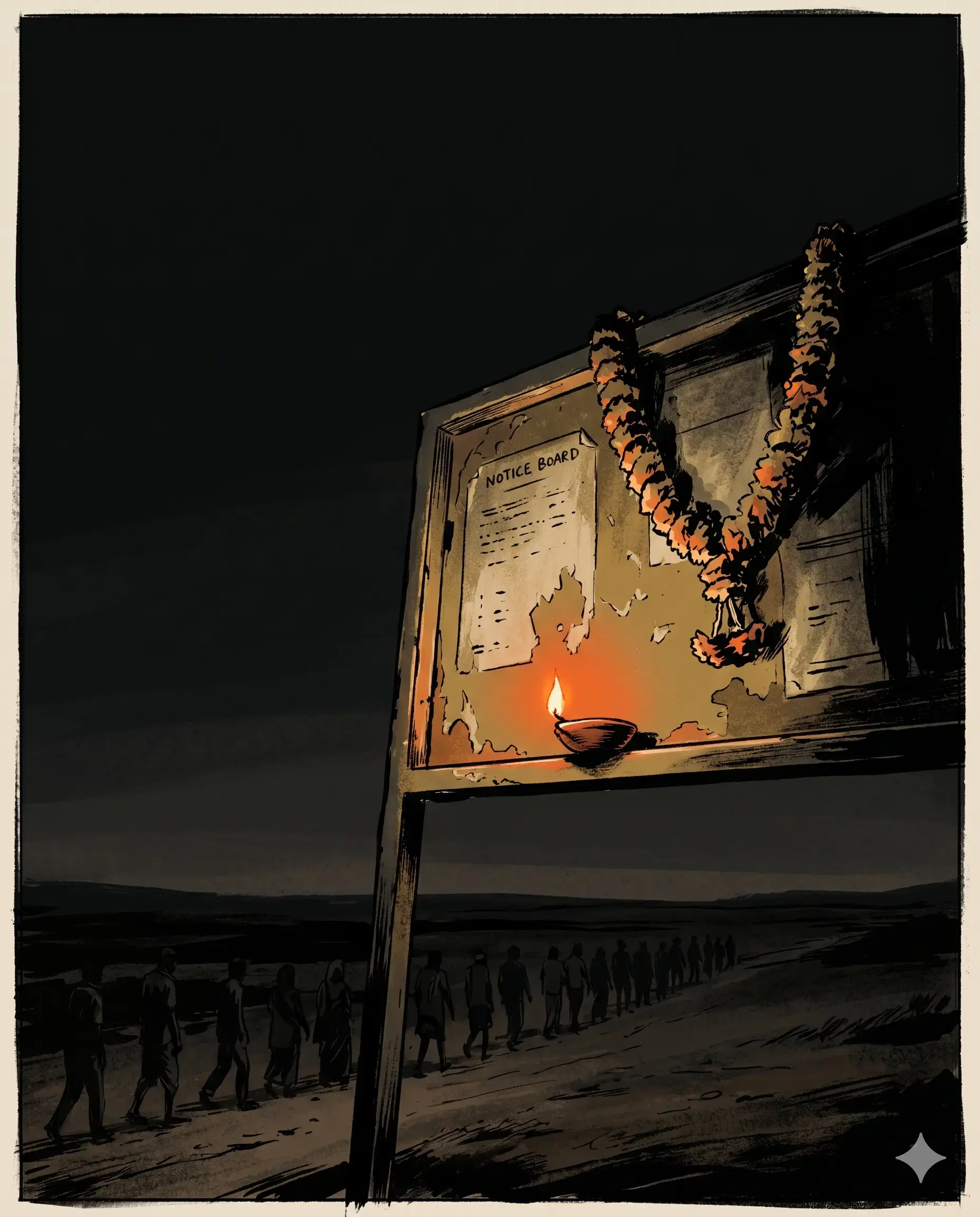
There is a town on the maps of my state that is only water now.
It had a name before it was a depth. It had a headman named Ramprit Sahani, a boatman, who could not write, and who sent four letters to the district — four — in a nephew’s careful hand, to say that the embankment above his people was going soft in the night, that the sand that held it was leaving the river by the truckload, that when the big water came his village would drown. Each letter was received. On each, the date of its arrival is recorded, and beside it, in four different inks, the fact that nothing was done. The third winter after the first letter, the river came exactly where an illiterate man had said it would, and took him, and four hundred and ten others, and the village became, on every map printed since, a smooth blue absence.
I am going to tell you how a machine built to return one widow forty-one rupees ended, twenty years later, holding those four hundred and eleven names.
I am going to tell you, before it is over, that one of the names it should have printed is mine.
Twenty years of retelling is a kind of editing; the sentences, I warn you, have improved with the handling. The events are exactly as they happened.
They keep asking me where it started.
Eleven Lakh
Aman Joshi walked out of the examination hall into the white March glare with the emptied calm of a man who has finally done a thing he has been about to do for six years.
The Combined Recruitment Examination. Eleven lakh candidates. Nineteen thousand posts. His fourth attempt and — by the rule that decided such things from a distance, like every rule that governed him — his last. He was twenty-four. He had spent the whole of his adult life in one small room above a photocopy shop, in a town that existed to sell hope in monthly instalments.
He had done well. He knew it the way a farmer knows the sky. Reasoning: clean. Quantitative: clean. Walking out, he allowed himself the thing he never allowed. He imagined the phone call home. He imagined his father saying nothing for a moment, which was how his father said the largest things.
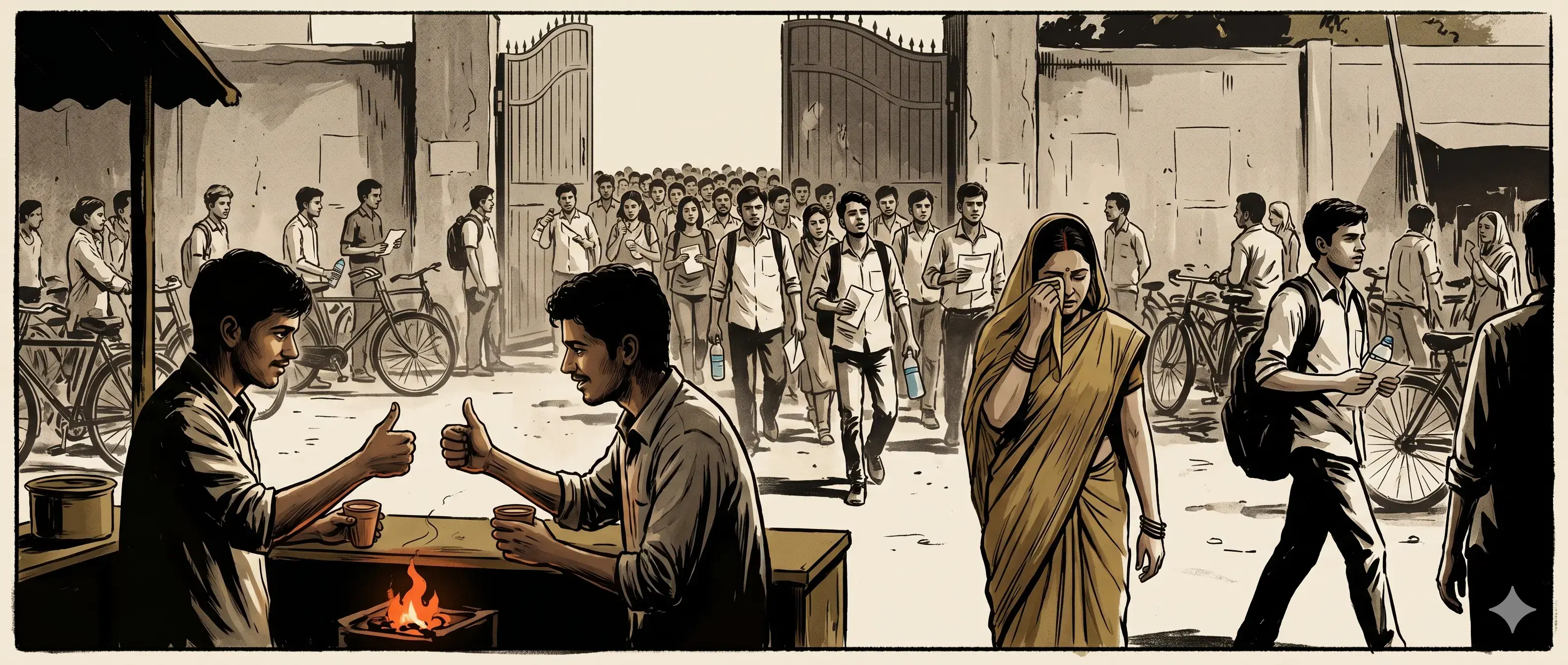
He bought a five-rupee kulhad of tea he couldn’t afford and stood drinking it among the others — all of them wearing the same dazed look of people who have set down a weight they have carried so long they no longer know who they are without it. A boy from his Reasoning batch caught his eye and gave him a small exhausted thumbs-up.
Aman gave it back.
That was the last clean hour of his old life.
The video arrived on the hostel group, thirty seconds, shot shakily off someone’s screen. Aman watched it on the edge of his cot with the fan dead and the power gone, and at first his mind refused it, the way a hand refuses a flame before the pain arrives.
It was the question paper. His question paper. The one that had been sealed, secret, equal — equality being the entire point, the only article of faith he had left: that he and the minister’s nephew sat down before the same blank page, and the page did not care who their fathers were.
The timestamp on the file was three days old.
The paper had been for sale before any of them entered the hall. Price: eight lakh rupees. Almost exactly, Aman noted, with the strange clerical precision that descends in the first minutes of catastrophe, what his father had borrowed against the house.
So the page had cared after all. It had simply never cared about him.
The Board’s statement was one line.
In view of certain irregularities, the Combined Recruitment Examination held on the 14th instant stands cancelled in its entirety. A fresh examination will be scheduled in due course.
In due course. Three words informing him, politely, that the years of his one life were an administrative error, regrettable, now corrected. As though twenty-four could be rescheduled. As though his father’s loan could be rescheduled.
The hostel that night made the worst sound he had ever heard, which was the sound of two hundred young men in adjacent rooms making no sound at all.
What Aman did not know yet — what almost nobody knew yet — was whose exam it had been. The Board that had stamped that one-line burial was the State Staff Selection Board. Appointed by the state government. Chaired by a man the Chief Minister herself had chosen.
The page had an owner. And the owner was about to get very, very lucky in the matter of who took the blame.
Aman waited six years for a result that never came. Press and hold to wait with him.
The Shrug
The District Magistrate of Naugarh learned from a WhatsApp forward, between a flood-relief review and a meeting about stray cattle, that her brother’s future had been cancelled — and she did what officers of her service are trained to do with a wound.
She scheduled it.
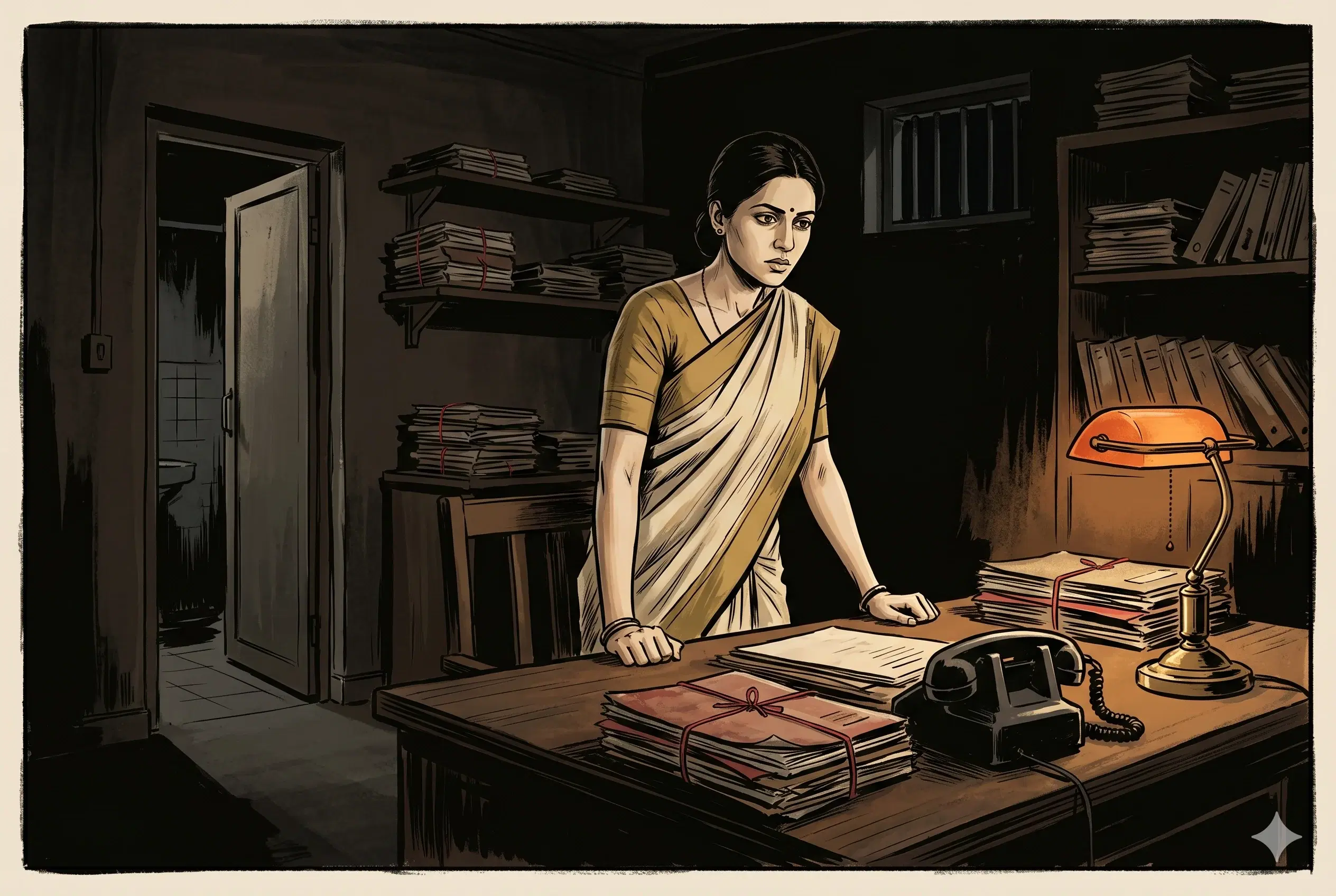
Meera Joshi, IAS, eight years in, finished the cattle meeting. The cattle, it was resolved, would be referred to a committee; the cattle had outlasted four such committees and were widely expected to outlast this one. She signed eleven files. She told her stenographer, Mishra-ji — who typed everything in triplicate including, she suspected, his own dreams — that she was not to be disturbed, and then she shut her office door and made three phone calls, carefully, sideways, to people she trusted inside the machine.
The first call told her the leak was real and traced to a coaching-mafia network in the west of the state.
The second call told her the network’s protection ran upward — through a personal assistant, into the office of a minister in her own government — and that the file containing this fact had been, in the gentle language of her service, taken on record. Which meant buried.
The third call she made to the one man senior to her whom she still wholly admired, and he listened, and was quiet, and then said the thing she would hear in her sleep for a year: “What to do, Meera. This is how it is now.”
And Meera Joshi heard herself answer, “Yes, sir. Of course, sir,” in the same tone — and put the phone down and was sick in the small attached bathroom of her government office, quietly, not because of the leak but because of the shrug. Because she had just heard it come out of her own mouth, fluent, native. Eight years inside, and the machine’s language had become her first language while she wasn’t looking.
That night she opened her laptop and typed four sentences of a resignation letter.
She read them twice.
Then she closed the laptop without saving, because of a sum she could do in her head: the family had one government salary left now, and one mortgaged house, and a brother coming home on a night bus with six years of waste paper — and the machine knew that sum too. The machine had always known it. That was how it kept its officers. Not with loyalty.
With arithmetic.
Two weeks later, a letter arrived from the Chief Minister’s office. The state government — her government, the one whose buried file she could quote from memory — was sending a Special Officer to Naugarh. Full administrative powers. Reporting directly to the capital.
Some outsider. Some famous engineer.
They were sending him to her district, and the order was signed by the office of Pranay Sahni — the man who, her second phone call had whispered, had personally managed the burial of the exam file.
Meera read the letter three times, and felt the armour go on, plate by plate, and thought: come, then. Let’s see what the government’s new toy looks like.
Four sentences, typed at midnight. You decide what she couldn’t.
Civics
Kabir Anand kept no television, on the grounds that it was the most effective instrument the system possessed — not for what it said, but for what it did to the inside of a head. So the news reached him the way news reached him now: late, sideways, through a student.
Fatima was nineteen, first in the door for every class, and she wanted — against all available evidence — to be an honest officer. Tonight she didn’t sit. She stood in the doorway holding her phone like something that had bitten her.
“Sir. Did you see.”
He watched the thirty seconds. The leaked paper. The eleven lakh.
“I see,” he said.
“That’s it? Sir, that’s the whole — eleven lakh people, sir. My cousin sat that exam. She sold her earrings for the form fee.” Fatima’s voice did the thing it did when she was trying not to let it shake, which was go very fast. “And you say I see like I’ve shown you the weather report.”
“What would you like me to say?”
“Something with a verb in it!”
The class was filing in behind her — the labourers’ daughters, the clerks’ sons, twenty small unlikely flames. Kabir looked at them for a moment.
“Sit,” he said. “All of you. Change of syllabus tonight.”
He wiped the board clean of the irrigation budget and wrote, in his careful engineer’s capitals, one word: LEAK.
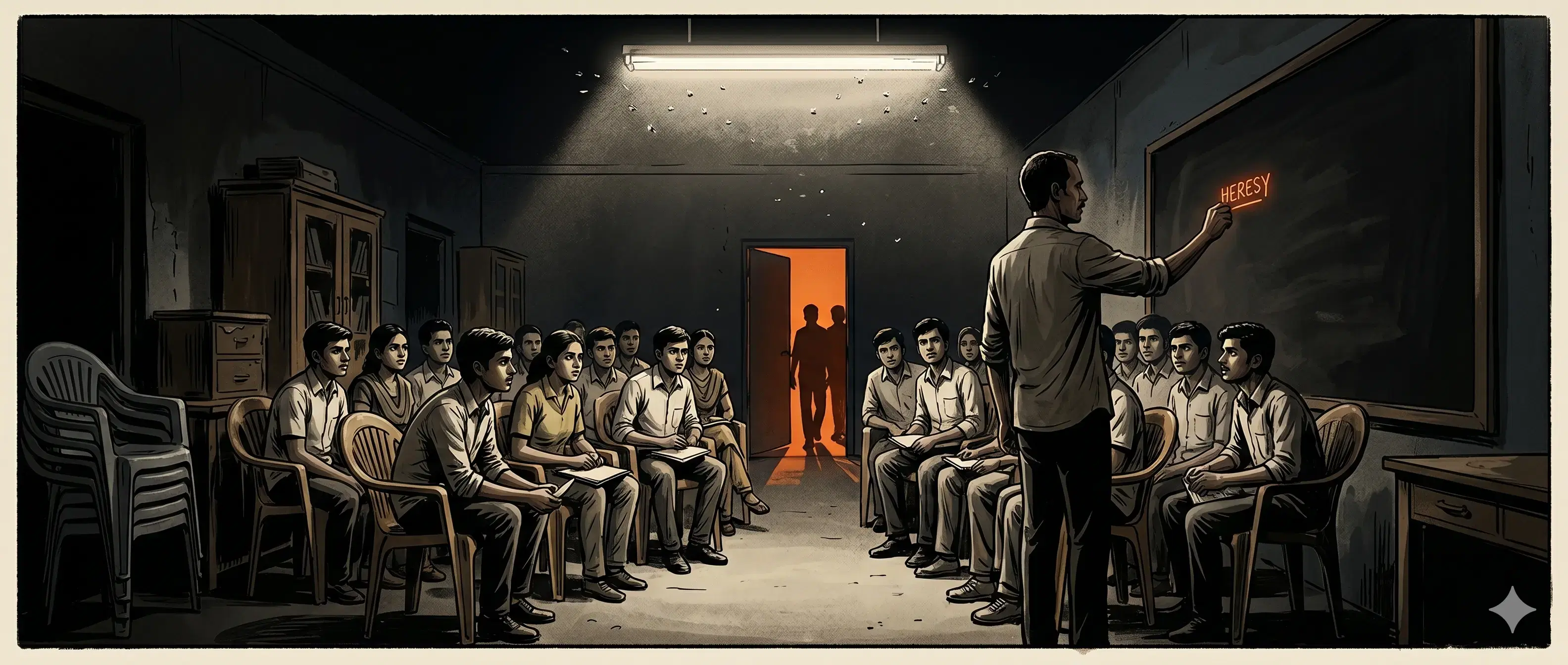
“An exam paper,” he said, “is a vault. Tonight we are going to do what nobody on your television will do. We are going to walk the vault, door by door — printing press, transport, strongroom, district custody — and at each door we will ask the only question that matters. Not who is corrupt. Anyone can ask that; it is a way of feeling angry while learning nothing.” He tapped the board. “We will ask: at this door, what does honesty cost, what does theft pay, and who set those prices? Because a leak is not a sin. A leak is a price signal. Somebody built a market and you are the goods.”
Four doors stand between a sealed paper and the bazaar — and at each one, Kabir’s question: what does honesty cost, what does theft pay, and who set those prices? Tonight, you hold the dials. (The sellers keep ₹2.2 lakh off the top — the network always pays itself first.)
He taught for two hours. He did not mention that he had once built the thing that made such markets impossible. He did not mention the state that had killed it, or the year they had spent unmaking him — the cancelled clearances, the inquiries that found nothing and never closed, the lesson conducted in public so that everyone watching would understand it without a word being said.
Above all he did not mention Ishaan, who had been twenty-three, who had believed him when he said it can be different, who had run the pilot in his own home district like a man carrying fire, and who had not survived the year the doors slammed shut again. A name, an age, a town, printed in the same grey type as the weather. Kabir kept him there, in the small type, because the alternative was to feel the whole of it at once, and a man cannot build anything feeling the whole of it at once.
After class, Fatima lingered, arms crossed.
“Sir. Honest question. You teach us how the machine works better than anyone alive. So why are you here?” She gestured at the borrowed room, the twenty chairs, the single tube light with its halo of insects. “Twenty students. That’s not a verb either.”
Kabir was a long moment answering.
“The verb you’re asking for is lead,” he said. “I don’t do that one. A thing that needs me in the room is theatre. If I ever build again, I will build to make myself unnecessary — the day it needs no one is the day it works.” He capped the marker. “So I’m waiting.”
“For what?”
“A foothold.”
It came eleven days later. It arrived in a pressed linen kurta, smelling of sandalwood and helicopter fuel, and it stood at the back of his Thursday class for forty minutes, smiling, like a man who has come to buy a horse.