Civics
Kabir Anand kept no television, on the grounds that it was the most effective instrument the system possessed — not for what it said, but for what it did to the inside of a head. So the news reached him the way news reached him now: late, sideways, through a student.
Fatima was nineteen, first in the door for every class, and she wanted — against all available evidence — to be an honest officer. Tonight she didn’t sit. She stood in the doorway holding her phone like something that had bitten her.
“Sir. Did you see.”
He watched the thirty seconds. The leaked paper. The eleven lakh.
“I see,” he said.
“That’s it? Sir, that’s the whole — eleven lakh people, sir. My cousin sat that exam. She sold her earrings for the form fee.” Fatima’s voice did the thing it did when she was trying not to let it shake, which was go very fast. “And you say I see like I’ve shown you the weather report.”
“What would you like me to say?”
“Something with a verb in it!”
The class was filing in behind her — the labourers’ daughters, the clerks’ sons, twenty small unlikely flames. Kabir looked at them for a moment.
“Sit,” he said. “All of you. Change of syllabus tonight.”
He wiped the board clean of the irrigation budget and wrote, in his careful engineer’s capitals, one word: LEAK.
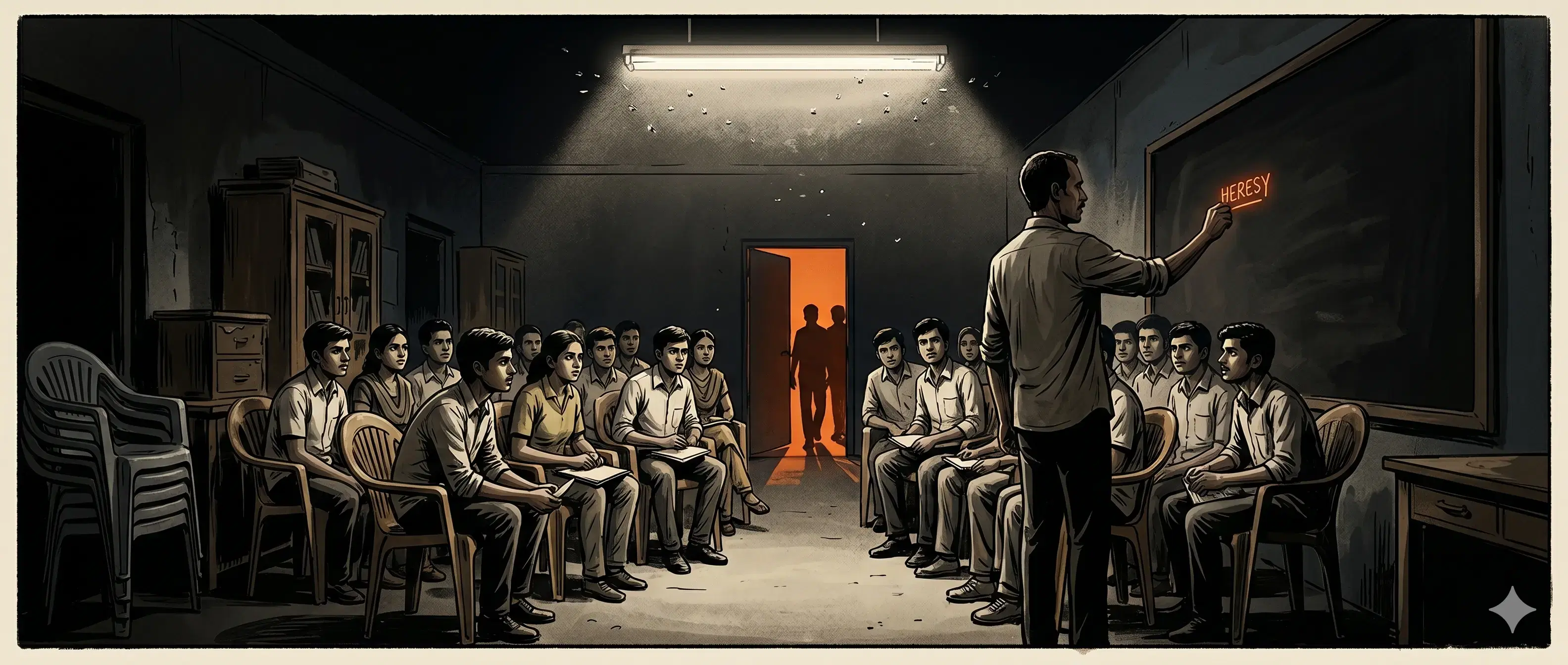
“An exam paper,” he said, “is a vault. Tonight we are going to do what nobody on your television will do. We are going to walk the vault, door by door — printing press, transport, strongroom, district custody — and at each door we will ask the only question that matters. Not who is corrupt. Anyone can ask that; it is a way of feeling angry while learning nothing.” He tapped the board. “We will ask: at this door, what does honesty cost, what does theft pay, and who set those prices? Because a leak is not a sin. A leak is a price signal. Somebody built a market and you are the goods.”
Four doors stand between a sealed paper and the bazaar — and at each one, Kabir’s question: what does honesty cost, what does theft pay, and who set those prices? Tonight, you hold the dials. (The sellers keep ₹2.2 lakh off the top — the network always pays itself first.)
He taught for two hours. He did not mention that he had once built the thing that made such markets impossible. He did not mention the state that had killed it, or the year they had spent unmaking him — the cancelled clearances, the inquiries that found nothing and never closed, the lesson conducted in public so that everyone watching would understand it without a word being said.
Above all he did not mention Ishaan, who had been twenty-three, who had believed him when he said it can be different, who had run the pilot in his own home district like a man carrying fire, and who had not survived the year the doors slammed shut again. A name, an age, a town, printed in the same grey type as the weather. Kabir kept him there, in the small type, because the alternative was to feel the whole of it at once, and a man cannot build anything feeling the whole of it at once.
After class, Fatima lingered, arms crossed.
“Sir. Honest question. You teach us how the machine works better than anyone alive. So why are you here?” She gestured at the borrowed room, the twenty chairs, the single tube light with its halo of insects. “Twenty students. That’s not a verb either.”
Kabir was a long moment answering.
“The verb you’re asking for is lead,” he said. “I don’t do that one. A thing that needs me in the room is theatre. If I ever build again, I will build to make myself unnecessary — the day it needs no one is the day it works.” He capped the marker. “So I’m waiting.”
“For what?”
“A foothold.”
It came eleven days later. It arrived in a pressed linen kurta, smelling of sandalwood and helicopter fuel, and it stood at the back of his Thursday class for forty minutes, smiling, like a man who has come to buy a horse.