ANTYODAYA
Prologue

The First Crack

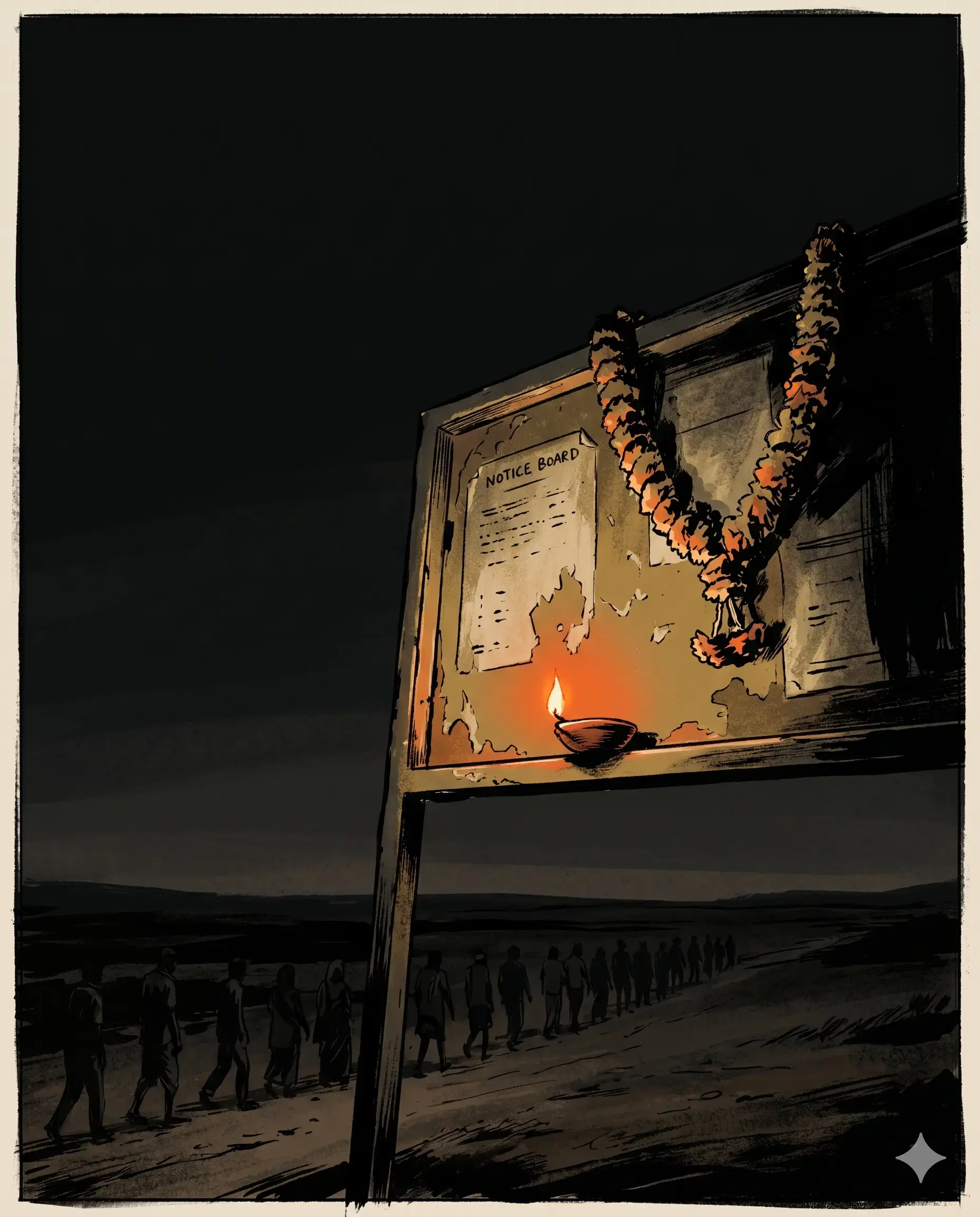
Cover Key Art

Meera Joshi · 2041

They keep asking me where it started. They want a date, a building, a speech. As if a country turns the way a key turns.

Twenty years I have been answering that question — at hearings, at memorials, once under oath — and the true answer has never satisfied anyone, because the true answer is small. It started with Lakshmi Devi, a ration card, and forty-one rupees.

Lakshmi Devi could not read. She had walked nine kilometres because her widow's pension had not come for fourteen months, and each month a man behind a counter had explained, with the patient cruelty of the small, that her thumb impression had not matched, that the server was down, that what to do, mataji, it is the system. It is the system. The four words under which this country has buried more lives than any famine.

What was different that morning was only this: behind the counter the screen was new, and on the screen, the man's own name sat above hers.

She pressed her thumb to a glass plate. She spoke into a speaker in her own dialect. No form. No fee.

The money moved while her thumb was still warm on the glass.

Fourteen months of pension — and forty-one rupees besides, which the system had calculated as interest. For the delay. As though her time had value. As though she were the kind of person to whom the state paid interest. And on the public board outside, where the whole village queued, a line appeared: the pension had been stopped not by a server, not by a thumb, but by a man, and the man had a name, and the name now stood beside the theft for everyone to read.

I watched her face when the boy read it to her. I want to tell you she wept, because that is the kind of thing we say. She didn't. She went very still — the stillness of someone discovering that a thing she had taken all her life for weather was in fact a decision somebody had made. And could be made differently.

The machine that did this belonged to a man named Kabir Anand. You know the name. You have seen it on the things this country puts names on, and you have seen it burned. But that year he was nobody — an engineer running one dry administrative district the maps remembered only when it failed to rain — and I was the District Magistrate he had been parachuted over, and I was certain he was a fraud. I had seen reformers before. They arrive with slide-decks and leave with portraits.

He wasn't even there that morning. That was the point, he told me later, the only time I ever heard him sound something like happy. "If it needs me in the room, it's theatre. I'm trying to make myself unnecessary. It's the hardest thing I'll ever build."

Those may not have been his exact words. They are the shape his words have worn into after twenty years of my carrying them, and the shape is true — and that is fair warning about this whole book, while we are at it. Retelling is a kind of editing. The events are exactly as they happened; the sentences have improved with the handling. You will have to decide, as I did, which of those two facts to trust.

I thought he was being modest, that day. I understand now he was telling me the entire tragedy in advance.

Because here is what no one wants in the documentaries: that morning was the beginning of the cure, and it was the beginning of the disease. When people have been failed for a thousand years and are then — suddenly, reliably — served, they do something far more dangerous than revolt. They exhale. They hand you their vigilance like a coat at the door, and they say: finally. Someone who will take care of it.

And a man who is handed a hundred million coats had better be very sure what he does with his hands.

They want to know where it started.

It started with forty-one rupees, and a woman learning, too late in her life and just in time for everyone else's, that the weather had been a man all along.

Everything that followed — the Act, the fire, the eye, the empty chair, the night they came for the founder with the clause he wrote himself — all of it was only this country doing what it had never once been allowed to do.

Counting. Out loud. To the end.